
AI After Midnight
The End of Creativity?

I came across this article the other day. It talks about how a production company - Amazon-backed, Fable Studios - is using AI to completely restore the lost portions of Orson Welles’s mangled second film, The Magnificent Ambersons.
Made in 1942, a year after Welles changed everything with Citizen Kane, Ambersons is seen as the masterpiece that could have been. R.K.O took the film from Orson during post-production, ripped out forty-odd minutes, and tacked on a happy ending. They then destroyed the excised footage. Orson’s career never recovered.
As a brief aside, though, Orson might have been a little complicit in his own undoing, as, according to the excellent multi-book biography I read on Welles, written by actor Simon Callow, Orson left a majority of post-production solely to his editor (and later-to-be great director in his own right), Robert Wise, while Orson went off to Mexico with Dolores del Río* and was uncontactable.
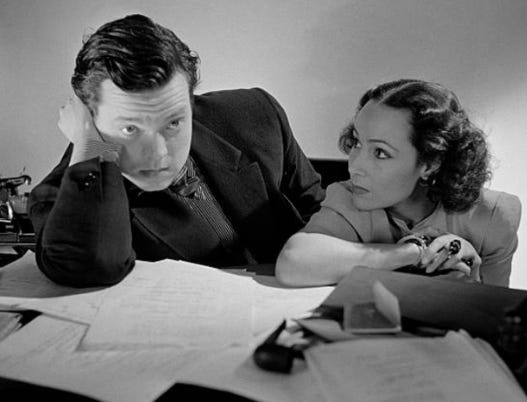
(Welles and del Río, 1941)
*Can’t say I blame him.
The lost footage of The Magnificent Ambersons has long been one of the great what-could-have-beens for cinephiles, and now, for good or ill (we’ll get into that shortly), Edward Saatchi, the CEO of Amazon-backed startup Fable, plans to show us exactly what Welles had in mind.
Fable is an artificial intelligence-powered media company based in San Francisco, and bankrolled by Amazon's Alexa Fund. Forbes called them “Hollywood’s worst nightmare”, while Saatchi himself has said that AI is “Possibly The End Of Human Creativity”. Probably said it with a smile as well.
There seem to be many arms to Fable. There is Showrunner, which creates generated cartoons and bills itself as the “Netflix of AI”, responsible, I believe, for the AI-generated episode of South Park, among others, and there’s also the frightening-sounding “The Simulation,” which, according to AI-powered Google, is “an initiative aimed at creating AI-powered virtual beings and interactive, simulated realities.”
The Magnificent Ambersons Project will use a hybrid approach (which is something, I suppose), filming live actors and then applying AI mapping to their faces and generating the voices of the original cast, all from Welles and Joseph Cotten’s screenplay, and possibly Welles’s original storyboards (I’m just hazarding a guess there, though).
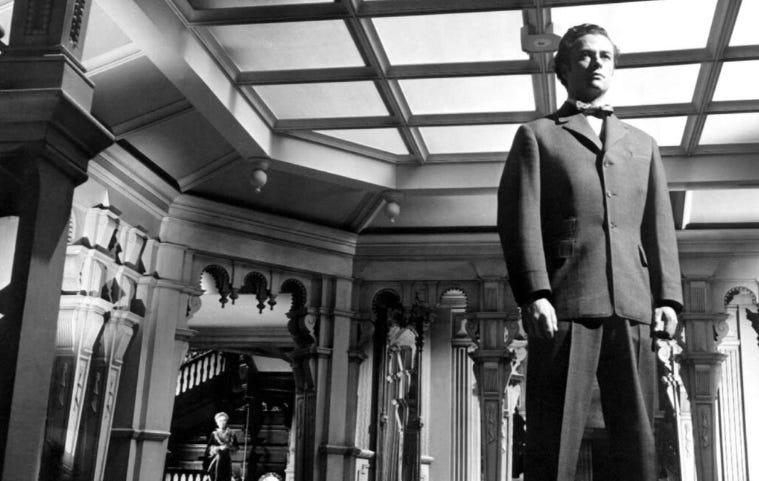
(Awesome shot from The Magnificent Ambersons, 1942)
There is no official release date for Saatchi’s recreation of The Magnificent Ambersons, but no doubt, when it is released, it will be controversial and polarising.
But also, it may open a door that probably shouldn’t be opened.
But undoubtedly WILL be opened, nevertheless.
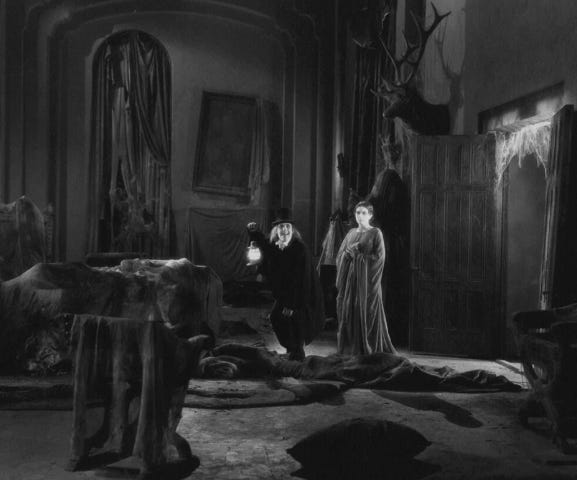
I’m seeing a future of AI-generated recreations of lost sequences, entire episodes of old TV shows, and even entire films. For instance, it occurred to me that it is now possible, or will soon be possible, to entirely recreate the most sought-after lost film of all time: Tod Browning’s 1927 chiller, London After Midnight, with the great Lon Chaney.
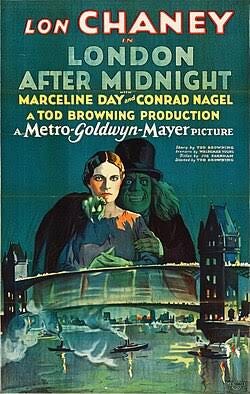
Browning and Chaney made ten films together between 1919 and 1929. All dark and macabre, usually about physically or mentally broken characters - all played with utter conviction by Chancy in an astonishing array of self-applied make-up and physical alterations. The films that remain in existence, such as The Unholy Three (1925), The Unknown (also 1927), and West of Zanzibar (1928), are quite something.
London After Midnight was one of their most successful collaborations, in Box Office terms, anyway, and features extraordinary and iconic make-up by Chaney, which, once seen, is never forgotten.
Stills from this film scared the hell out of me when I was a kid.
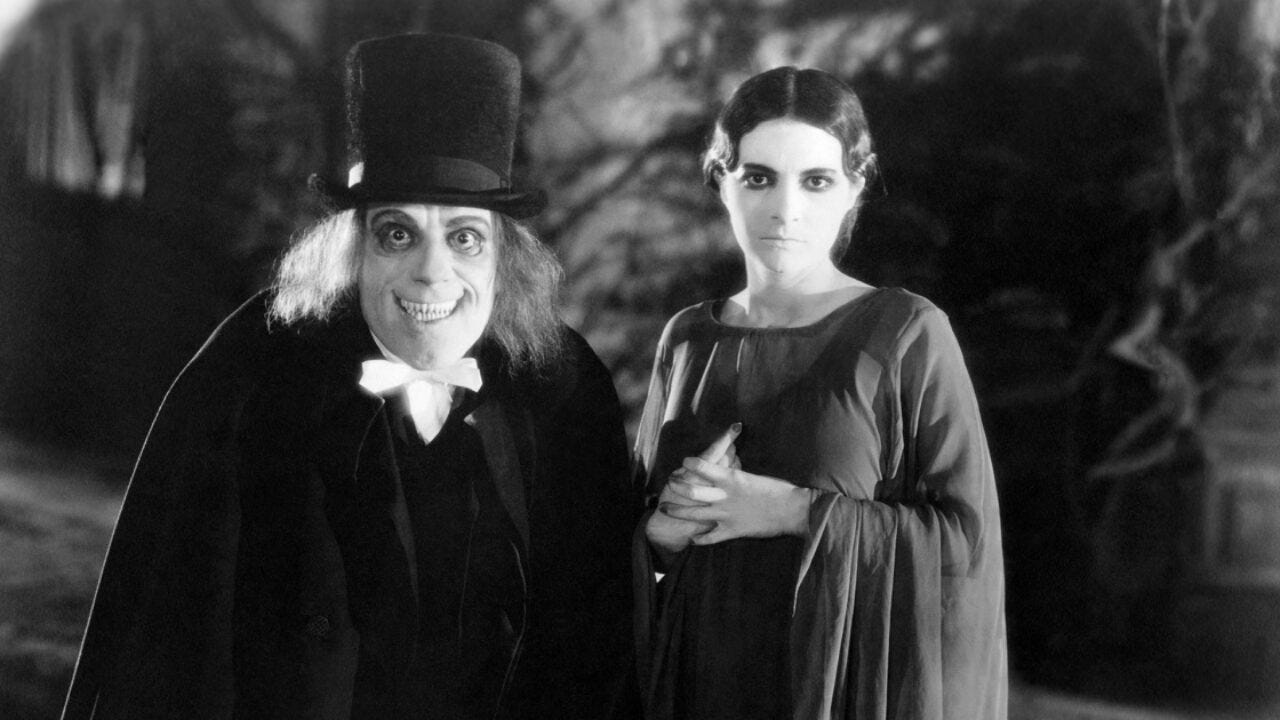
(lovely couple Lon Chaney and Edna Tichenor)
Still, for all its success and iconic status (although that may have developed later), the last known print of the film was destroyed in a fire on the MGM lot in 1965. Since then, it has become the Holy Grail of Lost Films. One day, a dusty old silver film canister may turn up in someone’s attic or archive, but no print has yet been found.
But now, with this new technology, it’s increasingly likely that an AI-generated version of this film will appear at some point. There are a lot of reference points as well. The full screenplay still exists, as well as countless stills. TCM even recreated the film in 2002 by using all the available stills. Plus, Browning remade the film himself as a talkie in 1935 with Lugosi, under the title, Mark of the Vampire. That’s a lot of reference points for a company like Fable.
Am I advocating it? No.
Would I watch it? Honestly, I probably would. If it was created at the level I’m imagining.
Is it wrong? Yes, well, it’s definitely a slippery slope. Reaction to The Magnificent Ambersons will more than likely be harsh. Or it’ll just be ignored entirely.
Or… it really will be the start of something, whether we like it or not.
The recent expanded version of The Wizard of Oz at the Sphere is another example of where this could all be heading. Frames stretched out by AI to provide an audience with a complete immersive experience.
What is undeniable, however, is that ChatGPT was dropped on an unsuspecting public in November 2022, and since then, Anthropic, OpenAI, Meta, Alphabet/Google, and seemingly countless other start-ups have been pushing the technology in an increasingly rapid arms race. I have friends who think this is all bollocks and that the bubble will burst, that public reaction will be a unanimous mass wave of pushback, and it will all become just another Crypto or some such. And I have other friends who are, well… prepping.
In the (not yet) four years since ChatGPT dropped, we have gone from that now-famous video* of Will Smith eating spaghetti to being able (maybe) to recreate Orson Welles’s version of The Magnificent Ambersons.
*Is video the right word for such… content?
So where will all this be in another four years? (I’ve found some of the clips on the Instagram account, Evolving AI, quite staggering.)
And what would Welles make of it all, an artist who spent the entire rest of his life chasing money and struggling to get his visions on screen? Would it repel the artist within him, or would he use his artistry to utilise it?
I can’t answer that, of course, but it makes me wonder.
For me, I am both fascinated by what is happening and also deeply concerned. I believe it will upturn the industry I’ve been trying to break into for nearly two decades. By what degree it’ll be upturned, I do not know, but I’m certianly keeping an eye on where all this is going. I can’t just dismiss it, like a lot of people I know, because, well, there’s no bones about it, it is here to stay, and it’s only going to get more and more powerful.
I will say this, though, in an effort to balance things out a little. There is nothing quite like being on the set of your own film, seeing your work come alive through a monitor screen. Seeing the actors working just beyond the lens. Being with the crew, creating something together. Because film IS collaboration. It takes an army, as they say, or in my case, a small band (which is how I like it). It is quite an incredible experience.
Films should be made communally, and also, they are best viewed communally, and all that is slowly being taken away from us.
I don’t know. Maybe it’ll all just level out, and AI will be used mainly for effects, replacing CGI and practical effects, which, of course, in itself does mean mass unemployment for countless artists. I met an “AI expert” a few weeks ago who told me that he now works as a consultant for production companies and streamers designing effects, plates, and other such things for major productions. He said all the big hitters are now using AI, but everyone is keeping it hush-hush because of public backlash. And the fact that most of us are watching films and TV that may already have extensive AI shots or effects, and we’re not always noticing (or caring), probably tells us a little about where we’re heading.
Disney announced in December that they have gone into a £1 billion agreement with OpenAI for a three-year licensing deal, which will allow fans to generate their own shorts from over 200 Disney-owned characters. And by Disney-owned, we mean Pixar, Marvel, Lucasfilm, and 20th Century Fox (which is what I know it as). So you’ll be able to make your own films featuring Ellen Ripley, Indiana Jones, Tony Stark, Buzz Lightyear, and Luke Skywalker, and probably have them streamed on Disney+.
That is insane, and it is also mass fan fiction. But where will it lead? Will some kid in Nebraska, or Mumbai, or even Skegness create the best Star Wars film since The Empire Strikes Back?
Who knows. I guess we’ll see.
We’re all gonna see, whether we like it or not.
The film students I have taught have no interest in AI whatsoever which I found interesting. The human craft and emotive connection still cuts through, mind you the Orson Wells application sounds interesting I like the way it can be there to fill gaps, perhaps maybe it could be used to restore the lost doctor who episodes one day.